The good Earth
Healthy soil ecosystems are rich in organic materials and living organisms. They are so structured that they drain well while retaining moisture. They contain abundant chemicals in the right balance to be useful to life, and few or none that are harmful. They are often dark in colour and a pleasure to smell and break up in the hand. They support natural and farmed ecosystems, and are key to the wellbeing of the biosphere and all its people. Preserving the health of soils has been a vital priority since humanity invented farming. And yet they are now endangered as never before.
Desertification Day
A UN conference in 1992 agreed Agenda 21 on sustainable development, and two new treaties: the CBD to preserve biodiversity, and the UNFCCC to resist climate change. But droughts and famines in Africa were fresh in delegates’ minds, and a treaty to prevent them ever happening again was also begun. This was the UN Convention to Combat Desertification in Those Countries Experiencing Serious Drought and/or Desertification, Particularly in Africa (UNCCD). It was adopted on 17 June 1994, and that date was to be marked as the World Day to Combat Desertification and Drought. This is to remind us where our food comes from, and that we cannot count on it for much longer if we continue to degrade our soils and other ecosystems, as well as our climate. For unlike other causes of food shortages, like market manipulations and wars, desertification strikes at food supply by undermining the health and vitality of soils.
Deserts and desertification
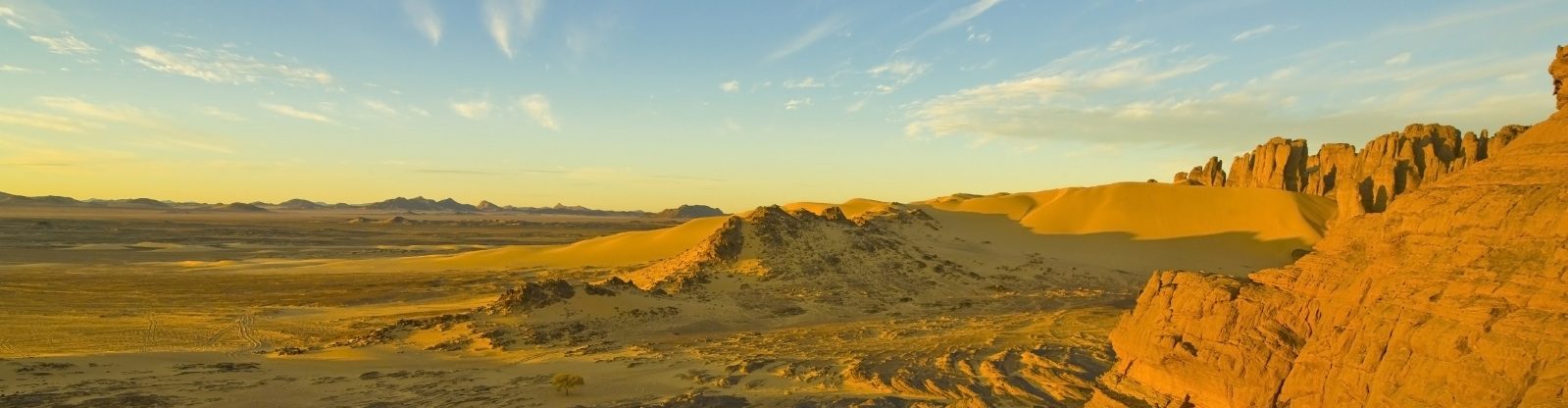
Natural deserts are diverse and fascinating ecosystems (pictured) where life is adapted to fewer than 250 mm of annual rainfall. But desertification is an insidious and unnatural process that destroys plant communities and soils. It can degrade the landscape until it becomes useless to people and everything else that once lived there. The cause is often a combination of over-grazing and poor farming practices to expose the soil, drought to weaken it, and wind to blow it away. But high rainfall can have a similar effect. Once vegetation is removed and roots die, water can wash the soil away to leave sterile sands and rocks that will take nature millions of years to restore. And excessive irrigation can create salty deserts, as water dissolves minerals deep in the soil, draws them to the surface, and leaves them behind when it evaporates.
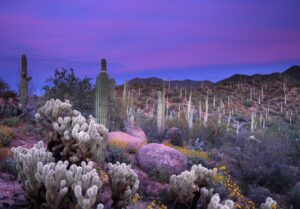
Saguaro National Park, Arizona
Spreading deserts
People who know too little ecology, or are desperate to grow food or graze livestock, can make deserts anywhere. Ecological ignorance is common among the powerful, and desperation is rising as climate change bites and inequality deepens. So desertification is underway in many areas. Nowhere is entirely safe, but it starts most easily in dry places. Hence it is widespread around natural deserts, such as the Sahel in Africa where the Sahara is advancing southwards. It is also severe in much of Central Asia, western China, the Indian states of Rajasthan and Chhattisgarh, and Mongolia. Other hotspots include the island of Madagascar, and parts of Brazil and Mexico. Moreover, with multi-year droughts in the south-western USA and Australia, farming systems designed for moister times are breaking down and being replaced by deserts.
Flash droughts
Drought is what we call a persistent lack of rainfall, relative to what we consider normal. It dries out soil and vegetation, aggravated by intense sunlight in a cloudless sky. If it continues, water levels fall in rivers and lakes, springs fail, and harsh consequences follow for people and the environment. For example, in the context of an Africa-wide drying trend, seasonal rains have failed for the last six years in the Horn of Africa, bringing widespread food insecurity. Climate change undermines everything we expect of our environment, making our adaptations to past conditions useless. Worse, droughts can no longer be relied upon to be gradual trends with slow consequences, which can at least be prepared for. Rather they have become more sudden and extreme. These new ‘flash droughts’ attack with no warning and rocketing temperatures, and can create desperation for people, livestock and wildlife within weeks.
Reversing desertification
Healthy soils and plant communities can withstand the effects of climate change much more effectively than damaged ones, and can cope with drought much better. So efforts to halt and reverse desertification focus on the protection and restoration of ecosystems, including the recharging of ground waters and the climate-proofing of farmlands. While there are some big flagship projects to halt advancing deserts, such as the Great Green Wall initiative in the Sahel, the general approach is to encourage and enable small-scale farmers to improve the soils in and around their communities. This is done by carefully managing water, crops and trees, and increasing the amount of vegetable material mulched into the soil. These simple techniques, multiplied by millions of participants, can achieve wonders.
Her land, her rights
Where women are most discriminated against, empowering them can unleash enthusiasm, cooperation and effective action on water supplies, small business development, and ecosystem restoration. Local participation and land care are critical to protecting and restoring farm and soil ecosystems, so the focus of Desertification Day 2023 is on women’s land rights and involvement. One aim is to promote laws and policies that end discrimination and secure women’s rights to land and resources. Another is to encourage businesses to invest in women’s equal access to land and other assets needed for ecological farming, land restoration and drought resilience.
The maw of desertification
A looming dust storm is a terrifying sight, with roiling brown clouds towering from the ground to a darkening sun and sky. When it hits, nothing is visible, paint is stripped, fabrics tear, and everything that humans have made is swiftly buried. Climate change can make such things far more common, along with coastal super-storms, choking smoke from forest fires, and torrents of mud, stone and water into our towns and villages. Our efforts to control GHG emissions have been pitifully small so far, with barely more on resisting ecosystem degradation. A new level of commitment is needed to halt the slide of our lovely world into the maw of desertification.
© Julian Caldecott