My talk at ‘The Cooler Earth Sustainability Summit’ in Kuala Lumpur (1st October 2019).
1. Introduction
Anxiety, frustration and risk are key themes of the climate and ecological emergency. Anxiety because nature is in free fall and signs of universal calamity are multiplying. Frustration because so little has been done to solve problems that have been anticipated for decades. Risk because of severe dangers to the biosphere, to human society and therefore to all businesses. This paper focuses on the Arctic ‘death spiral’ as an ecological risk that also illustrates the idea of tipping points, the Extinction Rebellion (XR) and Greta Thunberg’s Climate Strike as sources of transformative social change, and Malaysian opportunities for strategic leadership.
2. Ecological emergency
At the global level, human impact are known to have been exceeded safe limits in four areas: biosphere integrity, climate change, land-system change, and biogeochemical flows. These add up to key dimensions of the ‘climate and ecological emergency’: climate chaos, ecological breakdown, mass extinction. All have the potential to induce chaotic environmental change. Since our farms and cities depend on conditions that have been stable for nearly 12,000 years, any such change would be catastrophically damaging and could well prove fatal to humanity.
Since 1992, scientists organised through the Intergovernmental Panel on Climate Change (IPCC), Millennium Ecosystem Assessment (MA), and Intergovernmental Science-Policy Platform on Biodiversity and Ecosystem Services (IPBES) have shown us to be pushing the boundaries of biosphere integrity. Moreover, based on published evidence from many taxa, the Living Planet Index (LPI) shows a decline of over 60% in wildlife abundance since 1970 (Figure 1). In 2019, IPBES reported that close to a million species are threatened by human actions, while my own analysis implies that up to a million species are now becoming committed to extinction each year due to ‘web of life’ failures such as trophic shifts and the loss of co-evolved species.

Figure 1: The Living Planet Index: the decline of life on Earth since 1970
Natural ecosystems sustain water supplies, environmental security, pollination of crops, fisheries and soil fertility that cannot be replaced by artificial alternatives. Yet it became clear during the 2000s and 2010s that these ecosystems were deteriorating fast, exposing humanity and our farmlands and settlements to severe risks and costs. The overall message is that all the living systems that provide food, water and security for people and businesses are failing, and the failures are starting to join up. Each part of the pattern is a spreading desert, drought, wildfire, flood, storm, mudslide, epidemic, extinction, famine, or political crisis induced by them.
3. Climate emergency
From the analysis of air bubbles trapped in ice, the carbon dioxide (CO2) concentration of the atmosphere is known to have varied over time but to have remained below 280 parts per million (ppm, or 0.028%) for 800,000 years to 1950 (Figure 2). Our machines burn fossil fuels and produce exhausts mainly in the form of CO2. Land clearances have the same effect, by felling, burning, ploughing and planting natural forest and soil ecosystems. The world’s economy has grown since the Industrial Revolution, and especially since the Second World War, and not all of this carbon could be absorbed by oceans and plants. So around 1950 it began to exceed the Earth’s capacity to absorb it, resulting in raised atmospheric CO2 concentration.

Figure 2: Atmospheric CO2 – 800,000 years to now
This has been monitored on a mountain in Hawaii since 1958, yielding the Keeling Curve (Figure 3). Superimposed on seasonal variation as the biosphere ‘breathes’, this displays an underlying trend of CO2 levels rising through the previous ceiling of 280 ppm to reach the current level of almost 420 ppm, and continuing to increase at about 3 ppm annually. CO2 is transparent to short-wavelength light but is partly opaque to long-wavelength heat, so in the air it allows sunlight to enter the biosphere but inhibits the radiation of heat into space. This mimics the warming affect of glass windows in a greenhouse, so CO2 is called a ‘greenhouse gas’ (GHG).

Figure 3: The Keeling Curve – Atmospheric CO2 since 1958.
There are other GHGs, including several industrial ones (e.g. nitrous oxide, carbon tetrachloride, the chlorofluorocarbons, and sulphur hexachloride), and methane (CH4) from bacterial decay and fermentation of organic material in oil fields, livestock, soils and peat. Most GHGs are carbon-based, so they are often just called ‘carbon emissions’. Their combined effect on global heating (i.e. their collective ‘radiative forcing’ effect) is expressed as tonnes of CO2 equivalent (tCO2e). The tCO2e level was 0.041% in 1998 and is now 0.053%, and rising. Since methane is 20-80 times more potent as a GHG than CO2, total radiative forcing is bound to rise more steeply as methane is added to the mix. The world has so far heated by about one degree in a hundred years, more in the Arctic than elsewhere, and mostly since 1980. This heating has been enough to disturb ocean currents and rainfall patterns, and to melt ice, causing ecological risks.
4. Ecological risk
Risk judgements combine assessments of danger (what might go wrong), probability (if it’ll go wrong), and timing (when it might go wrong). Assessing risk requires knowledge, and scientists have now developed a clear sense of ecological risk in the present global situation (Tables 1-3).
| Table 1: Three things that might go wrong (severe dangers) |
| Climate chaos: dramatic change to climatic conditions that have prevailed over thousands of years, to which our farms, settlements, businesses, etc., are adapted. |
| Ecosystem breakdown: the failure of millions of ecosystems, so that they can no longer provide ecosystem services at local, national or continental scale. |
| Mass extinction: the extinction of millions of wild species, including very ancient lineages and species that pollinate crops or maintain soil fertility. |
| Table 2: Three reasons why things are likely to go wrong (high probabilities) |
| Climate systems: assessments using knowledge of system turbulence, past behaviour, greenhouse effect and physical chemistry, observed changes and their human causes. |
| Ecological systems: assessments using knowledge of evolutionary history, ecological rules, responses of known ecosystems, observed changes and their human causes. |
| Extinction processes: assessments using knowledge of past mass extinctions, needs of wild species, patchy distribution of wild species, observed changes and their human causes. |
| Table 3: Three reasons why things may soon go wrong (imminent timings) |
| Worsening trends, such as polar and glacial ice melt, and drying and burning trends in the Amazon Basin, southern Europe and South-east Asia. |
| Recent changes, such as deforestation in large parts of the equatorial tropics, desertification, declining wildlife populations, etc. |
| Approaching ‘tipping points’, in which systems change suddenly from one stable state to another, through a brief (milliseconds to millennia) chaotic transition. |
5. The idea of tipping points
Of the dangers, likelihoods and timings in Tables 1-3, only tipping points are uncertain in the sense of being inferred rather than demonstrable. The idea occurs often in the social sciences, where it is relevant to fashion, marketing, political consensus and Zeitgeist (the ‘spirit of the times’), and in the natural sciences of physical, chemical and biological systems. In the present context it raises doubts over whether we can manage major environmental change at all, other than by using a precautionary approach. The latter means doing only things that have been proved to be harmless, thus avoiding negative but unpredictable consequences, rather than starting with actions that are easy and profitable, and then trying to manage the consequences. Ecologists prefer precautionary approaches, and they do work well for example in fisheries, where the alternative ‘maximum sustainable yield’ approach is ineffective, but they are slow and cautious, the opposite of ‘get-rich-quick’ schemes. In general, they appeal more to pessimists than to optimists who are also inclined to expect technological fixes to solve complex problems.
The other problem with the tipping point idea is that it needs ‘systems thinking’ to understand – an awareness of how complex systems behave. Complexity is familiar in the worlds of finance, business and ecology, but politicians and media people are more used to simplicity. It is hard to reduce complexity to simple political messages, making it hard to explain the need for change. Rejecting the messages of ecology and complexity can also be an excuse to protect ‘business as usual’, which may appeal to those who are doing well out of it. Experience has shown that such people will tend to resist the tipping point idea, even after all the other elements of ecological risk have been accepted. Fear of accepting truth can be so strong that even the smallest limit to scientific certainty may be used to justify denial of the problem.
6. Ecological tipping points
Several large-scale ecological tipping points are currently at issue. Deforestation in the Amazon basin, for example, which is now at about 20% of land area, is thought to be very close to the point where there will be insufficient rainforest to maintain the region’s moist climate. Sustained and repeated drought would then permit the rapid replacement of all forest by fire-maintained grassland. A similar scenario is in prospect in Borneo and Sumatra. In all three cases, forest and land fires are underway and consistent with the tipping point prediction, with catastrophic implications for tropical biodiversity, environments and livelihoods.
The case of the Arctic further illustrates the tipping point principle, and poses a clear and present danger to all life on Earth. Figure 4 represents the ‘Arctic death spiral’, so called because it displays in spiral form the volume of sea ice in the Arctic ocean declining in the period 1979 to 2019, its depth having been measured by military submarines and its area by satellite imagery. Here it is notable that before 1980 there was little seasonal variation in sea ice volume as so much of it was in the form of deep, multi-year ice. Then, in the 1980s and 1990s multi-year ice declined and seasonal effects became more marked, and after 1997 most of the ice became single-year and began dramatically expanding in the winter and contracting in the summer.
![]()
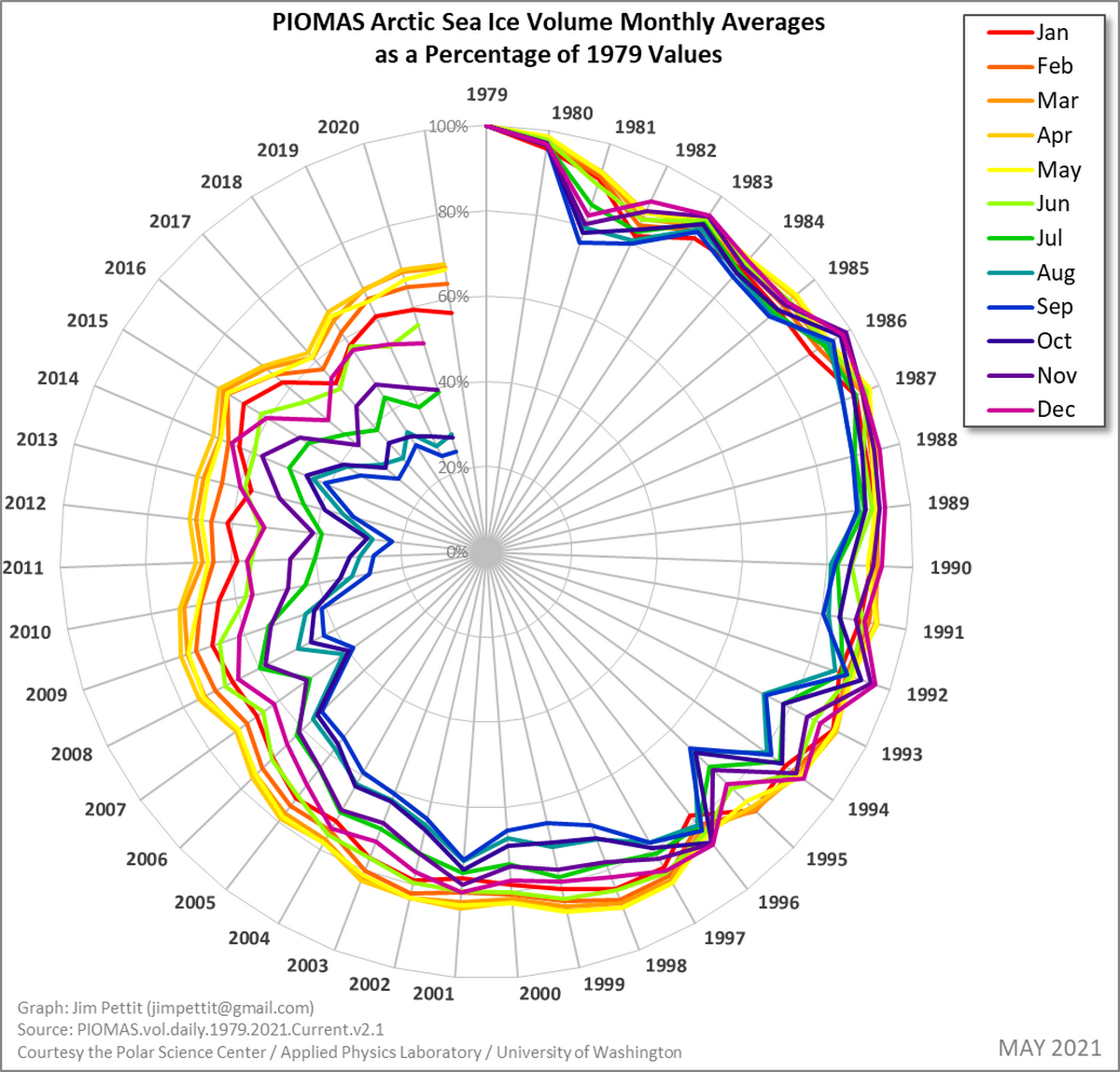
Figure 4: The Arctic ‘death spiral’
The declining minimum ice volume in September each year (the innermost line) is the key, since from the trends visible this seems likely to approach zero in the early 2030s. To appreciate the significance of this, it is necessary to understand several processes that are at work in the Arctic system: melting sea ice, melting peat, methane release, and fire (Box 1).
| Box 1: Processes of ecological risk in the Arctic ‘death spiral’ |
| Melting sea ice.
· The ‘mass-melting’ effect. It takes 80 times more heat to melt ice than to warm liquid water, because of the difference between the ‘heat capacity’ of water (i.e. it takes one calorie or 4.186 joules to heat one gramme of water by one degree) and its ‘latent heat of fusion’ (i.e. it takes 80 calories or 334 joules to turn one gramme of ice at -1o to liquid water); thus, much of the extra greenhouse heat in the biosphere has so far been melting ice rather than warming sea water.
· The ‘area-reflectivity’ effect. Ice is white and reflective, so its declining area means that more summer sunlight is absorbed by the relatively dark waters of the Arctic ocean.
Melting peat.
· The Arctic system comprises large areas of land in Siberia, Canada, Alaska, northern Finland and Scandinavia and elsewhere within the Arctic Circle, including several trillion tonnes of carbon-rich organic peat that has existed for millennia as wet but frozen permafrost.
· Arctic warming is two or three times faster than the global average, leading to large-scale melting of permafrosts and the decay of peat.
Methane release.
· Decaying Arctic peat is releasing tens of billions of tonnes of methane annually, adding significantly to the 50 billion tCO2e released worldwide from all other sources.
· At least 1.4 trillion tonnes of methane exist in frozen, water-bonded form in shallow sea-beds around the Arctic Ocean, and these molecules become unstable when warmed even slightly.
· Methane degassing around the Arctic is already underway, and would be expected to increase dramatically with heating of the Arctic Ocean.
Fire.
· As permafrosts melt, water is released and soils dry out, allowing land and forest fires to occur which are now underway throughout the Arctic Circle territories.
· These fires release CO2 and smoke, soot from which darkens the remaining ice and speeds its melting under sunlight, contributing to the observed rapid melting of the Greenland ice cap. |
7. The Arctic tipping point
The melting and burning in the Arctic since 1979 is from the small amount of global heating so far, as a result of carbon emissions from industry and deforestation since about 1950 when the ‘carbon balance’ tipping point was reached for the biosphere as a whole. With no ice to absorb extra greenhouse heat in the 2030s, Arctic water will heat up very quickly, accelerating the melting and decay of permafrost peat, and the release of methane. Methane is much more potent as a GHG than CO2, so the sudden release of several trillion tonnes of it (i.e. a hundred trillion tonnes or more of tCO2e) during the 2030s and 2040s will greatly amplify the worldwide greenhouse effect, no doubt causing total climate chaos, decades of starvation, war and refugee movements, and the transformation of all societies and businesses. The forms of the Keeling Curve and Arctic ‘death spiral’ show that humanity has not yet taken any effective action to head off the Arctic tipping point. Moreover, we currently have no way to mitigate or undo such a rapid and massive methane release should it occur.
This strategic issue only came to prominence in 2016, with the publication of Peter Wadhams’ book A Farewell to Ice. We will clearly need to do several things at once about this, as a matter of the highest global importance. First, we must become much more effective at reducing net GHG emissions in general, to mitigate climate chaos and Arctic melting as far as possible. This is already a universal priority, at least in principle, with efforts focusing on decarbonising the world’s economy through renewable energy, energy efficiency, cleaner production, etc. They will need to be accelerated greatly through such measures as fixing a high, stable price for conserved carbon (to encourage decarbonisation investment), rationing emissions either directly and equitably, or through taxation and pricing, and using all available policy tools in whatever mix may be politically possible in each and every country.
Second, we must find ways to recapture GHGs from the air rapidly and at scale. Massive reforestation, forest rewilding and organic farming projects are vital (and can have additional benefits for biodiversity and ecological services), but are slow to implement and require carefully-crafted social arrangements to be effective (e.g. to resolve issues of land tenure and community motivation). But the Arctic issue shows that there is also a need to absorb a trillion tonnes or more of methane in the 2030s, so new technologies will also have to be developed in the 2020s. These would ideally, and obviously, be based on the discovery of catalysts to break down methane under open-air conditions into elemental carbon for safe storage out of contact with the air, and the roll-out of technologies to use them. The search for such catalysts could be started by a government or financial institution offering a large prize for their discovery. Why should this strategy not be driven by Malaysian financiers, scientists, and corporations?
Third, we must adapt to changes that cannot be avoided by strengthening ecological and social systems against climate chaos, recognising that stronger systems can survive some stresses that would destroy weaker ones. And fourth, the long-term goal must be to stabilise the human and biosphere system so that it becomes permanently able to prevent any repetition of the current imbalance. While the details of such a stable system cannot be predicted, its main features of social equity, participation, accountable governance, long-term precautionary thinking, sustainable use of renewable natural resources, and supportive values and belief systems can be anticipated, and its foundations can start to be built (and unhelpful foundations avoided).
These four priories can be summarised as being to minimise emissions, recapture emissions, adapt to chaos, and stabilise the human-biosphere relationship (MiRAS). Malaysia could develop the concept for a global MiRAS strategy for presentation at UNFCCC CoP 26 at Glasgow in 2020.
8. Social risk and opportunity
The climate and ecological emergency was anticipated by far-sighted scientists in the 1960s, and became a scientific certainty in the 1970s, a popular cause in the 1980s, and the object of international agreements in 1992 with the signing of the UNFCCC and CBD. Progress since then, however, has been inhibited by various kinds of organised resistance. Angry frustration and fear of the consequences finally boiled over in August 2018, when Swedish schoolgirl Greta Thunberg (Figure 6) began her Climate Strike outside the parliament building in Stockholm, and over the following year several million other school-children became involved in similar actions.

Figure 6: Greta Thunberg as an icon of biosphere salvation (by Florence Thornton)
During 2019, Greta addressed parliaments and intergovernmental meetings across Europe and was nominated for the Nobel Peace Prize, and in September she travelled by yacht to New York to address the UN and begin a speaking tour of the Americas. Her movement broadened dramatically in October 2018 with the launch of the Extinction Rebellion (XR) in London, at which Greta spoke alongside a range of spiritual and ecological thought-leaders. The two movements have since reinforced one another, with millions of people involved in street protests and non-violent direct action on behalf of XR (Figure 7).


Figure 7: ‘The seas are rising and so are we’ – XR street protests in Bath, Bristol and London, 2019.
These protestors are scared, frustrated and angry, and they are unlikely to stand down because so many have been educated over years by David Attenborough and others, and because weather disasters and media reports around the world will continue, along with direct experience of heat-waves and storms. Hence the protests of 2018 and 2019 may be just the beginning of a growing and permanent wave of protest, focused on three primary demands:
- for truth-telling based on the science, and official declarations of climate and ecological emergency;
- for urgent action against GHG emissions, based on scientific realism (i.e. what is needed for survival) rather than political convenience (i.e. what is cheap and easy), with a binding, early goal of zero net carbon emissions; and
- for governance reforms built on citizens’ assemblies, to provide leadership and participation in solving the climate and ecological emergency.
The XR and Climate Strike movements have induced some national parliaments and many local councils (including a majority of those in England) to declare ‘emergencies’ and commit themselves to zero net carbon goals. Some national governments, however (notably the USA and Brazil) have rejected these demands out of hand. While gaining experience and confidence, both XR and the Climate Strike movements have deepened their critiques of ‘business and politics as usual’, and articulated increasingly ambitious ideas for urgent change. As with any demanding mass movement, therefore, the challenge for government and business is to accept enough reform to defuse the protests without sacrificing orderly governance and elite prosperity. This situation has no precedent, however, in that the protestors are driven by an awareness of ecological reality and a wish for society to comply with the laws of nature, rather than solely by ideals of social justice.
In any case, these movements share a direction of travel with a number of more ‘establishment’ initiatives that are also pushing businesses and societies towards urgent action on the emergency. For example, from mid-October 2019 the Bank of England as a Prudential Regulation Authority will require all financial businesses to appoint people who are responsible and liable for climate risk, to allocate sufficient resources to deal with climate risk, to report transparently and accountably on the management of climate risk, and to provide evidence of compliance. As Ben Caldecott observed at the ‘Net Zero by 2050’ Conference at Rothamsted in September 2019, the policy implications of this are profound, opening the way to stronger policy signals to overcome loss aversion and encourage investment in climate resilience. As he concluded: “If ever there was an area where it would make sense to take money from the future and spend it now, this is it!”
9. New social priorities for business
Science accurately describes ecological reality, and public alarm responds to a correct perception of that reality. Ignoring ecology is therefore no longer a viable option. Media reports are bound to encourage public anxiety and increase pressure on politicians and markets to ‘do something’ about the emergency. The costs of change are far higher now than they would have been in the 1990s, but meeting the need for change does not have to be a disaster for businesses. The efforts of XR, Climate Strike, Bank of England and other institutions and individuals are yielding new values and social priorities that are likely to respect survival, equity and honesty more than consumption, competition and choice. These will yield new basic laws and economic theories, new responses to business misbehaviour, and new expectations of how a creditworthy business ought to act (Tables 4-6). Businesses that adapt to this new social environment, and that also survive climate chaos, ecological breakdown and mass extinction, should become or remain profitable – and those that find new and appropriate niches in the emergency and the (hoped-for) post-emergency economy may do well.
| Table 4: Emerging expectations of basic law and economic theory |
| Prohibiting ecocide, to make ecocide – the deliberate or negligent destruction of natural ecosystems and species – a criminal act under international law. |
| Peace with Nature, to amend or write national constitutions to place the laws of ecology above human laws (i.e. that ‘parliament is sovereign, but nature is supreme’). |
| Wellbeing economy, to re-write the assumptions of economics and policy (e.g. in Scotland, Iceland and New Zealand) in line with new criteria for long-term public well-being and ecological health. |
| Table 5: Emerging responses to business misbehaviour |
| If a business is not seen to comply with the new social priorities then it may be punished by consumer boycotts or direct action. |
| If a business simply cannot comply, for example if its business model is based on air travel by jet, it may be abandoned by its customers. |
| If a business does not comply with legal requirements on reporting its climate actions and vulnerabilities, then it may be fined or suspended from trading. |
| If politicians (or markets) adopt a precautionary approach to ecological tipping points, then some asset values can collapse suddenly and completely. |
| Table 6: Emerging expectations of creditworthy businesses |
| Homework. Businesses should actively seek to discover their unique strengths and weaknesses, vulnerabilities and opportunities in the climate emergency. |
| Knowledge. Businesses should hire the best available ecological minds to engage with ecological reality, and to demonstrate a willingness to change. |
| Partnerships. Businesses should reach out and build genuine partnerships with public, academic and other institutions, and with shareholders and regulators. |
| Leadership. Businesses should encourage, enable and re-educate governments to help them adapt through fair and sensible regulation to the new rules of the climate emergency. |
10. Nature cannot be fooled
The Keeling Curve and Arctic ‘death spiral’ are top-level indicators of the state of the biosphere. They trace the net effect of trillions of actions and transactions that month by month affect the physical chemistry of the living world. They report an imbalance in human activity relative to all other organisms and processes on Earth, and in their present forms they imply a catastrophic near future for humanity and all other life on Earth. Over coming decades, the Keeling Curve must be flattened out and start to fall, and the lines representing Arctic summer sea ice volume must cease their orbit toward zero.
It is tempting to say that nothing else matters, but this is not so. Our aim should be to achieve these things while also laying the foundations of a benign human-biosphere relationship, and ideally a benign human-human relationship was well. We should do nothing in the short term that prevents our learning the lessons that we will need in the long term. On the other hand, we must save ourselves so that we can re-grow, and as much as possible of nature so that she can re-grow (making recovery of the LPI necessary as well).
And these acts of salvation must be real; there is no longer any role for greenwashing or pretend marketing. A mixed strategy is called for, based around the MiRAS priorities: minimising GHG emissions, recapturing past emissions, adapting to change by strengthening social and ecological systems, and refashioning human society and our relationship with nature. It is of course possible to list parts of such a mixed strategy, where businesses, investors, regulators and broader society can collaborate to take specific measures to reduce GHG emissions (Table 7) and adapt to chaos (Table 8). Of these, the adaptation opportunities are least understood, since we cannot always know what will work best in chaotic conditions, but we can take a precautionary approach and use ecological common sense to build resilience. A current book project to clarify these matters is outlined in Box 2.
| Table 7: Three kinds of opportunity in minimising net GHG emissions |
| Finding the catalysts needed to break down GHGs into elemental carbon in open-air conditions, and in mass-producing the negative-emission technology to use them effectively (with methane as top priority because of the Arctic methane eruption). |
| Contributing to decarbonising the economy, with businesses finding out (often with the advice of lenders, government and UN knowledge management systems) where they can make real emission savings from renewable energy, energy efficiency, insulation, recycling, etc. |
| Protecting forests and planting trees – that is, large areas of native species to sustain local biodiversity, and to protect them against pests and fire (large-scale reforestation and rewilding being an effective way to trap carbon, save biodiversity, and restore ecological services), usually best done with the full participation of local communities and in their own interests. |
| Table 8: Three kinds of opportunity in adapting to climate chaos |
| In the forestry and land use sectors, managing and restoring water catchments and ecosystem defences against floods, storms, fires and the spread of deserts, usually best done through partnerships with the societies affected and involved. |
| In the public health, health care and biomedical sectors, developing preventative and curative systems and medicines with which to anticipate and respond to the medical effects of climate chaos (including water-borne diseases, new vectors and disease profiles, and heat waves). |
| In the agriculture sector, since ecosystems full of wild species tend to resist diverse stresses better than simple systems, and they also store more soil carbon, organic farming as a way to meet aims for food (sustainable diversification), health (pesticides and disease vectors), biodiversity (preserving the web of life), adaptation (soil restoration and catchment protection) and mitigation (soil carbon capture). |
| Box 2: Adapting to Climate Chaos by Strengthening Ecological and Social Systems |
| This book by Julian Caldecott, recently commissioned by Cambridge University Press, aims to discuss the problems of anticipating chaotic change. It will present evidence from evaluated aid programmes that the fragility of these complex systems can be reduced by promoting public understanding of ecology, the sharing of knowledge, and locally-accountable leadership. These topics have extreme urgency since climate chaos, mass extinction and ecosystem breakdown are recognised features of our immediate future, and tipping points in major systems such as the Arctic and Amazon are imminent. While accepting the need to bring GHG emissions under strict control, adaptation is also a priority, especially for those concerned with sustainable development. Simple engineering solutions are often not enough, and the aim is to describe effective new ways to make it easier for citizens, leaders and aid professionals to make replicable strategic choices that reliably strengthen ecosystems and societies. |
Lists such as those in Tables 7 and 8 are indicative. It is better for people to study ecology and understand how everything fits together and influences each other, so that wise decisions can be made consistently and well. The good news is that ecology is not hard to understand, and public opinion and regulations are changing to make it easy – and necessary – to pay more attention to it. When people elect ecologically-aware lawmakers, then businesses can hire ecologists just as fast as they hire lawyers and accountants. Also, while nature is remorseless and all-powerful when provoked, she has great power to help put things right again if people allow it. Human ingenuity and enterprise may be able to do the rest.
© Julian Caldecott, Schumacher Institute for Sustainable Systems