This essay was short-listed in the 2021 ‘YESsay’ competition run by the National on Sunday newspaper (the winning entry is here). It sought to answer the question ‘Why should Scotland be independent?’, with the aim of informing and swaying undecided voters in the direction of voting ‘yes’ in the next referendum on the subject. The Green-SNP alliance Scottish Government is seeking such a referendum by the end of 2023. This would be the second, the first being in 2014 when the real question was ‘should Scotland leave the EU as well as the UK?’ Now the issue is whether Scotland should leave the UK in order to be free to rejoin the EU, which is a very different matter. The text of my entry follows.
Independence means having the freedom as a country to decide what to do, and to take responsibility for the benefits and costs of doing it. Contemplating independence, it is natural to ask what one’s country could do with its freedom. In Scotland’s case, competing visions might include: re-joining the EU and being able to trade and travel more easily, participate in European affairs more fully, and promote climate emergency responses more effectively; or else, being impoverished by the withdrawal of English funding, and becoming vulnerable to capital flight.
Many other scenarios are possible, but before a decision on independence is made they will all be speculative. For instance, neither the terms by which Scotland and England would part ways, nor the terms on which Scotland would re-enter the EU (or even whether it would apply to do so), can have been agreed bindingly before the vote. The most anyone can do is to promise to try to achieve certain outcomes if conditions allow, and if they remain desirable.
But circumstances constrain probabilities so, for example, Scotland is very unlikely to be able to re-join the EU in the next decade or so without independence. As a ‘Brexit migrant’ from England, one of my dreams is to obtain a Scottish EU passport before my British EU passport expires in 2026, and this affects how I think about independence. Considering the general catastrophe of Brexit, many Scots will have a similar ambition.
Such simple hopes may help to guide us through a turbulent campaign, in which narratives will proliferate as the vote approaches. Potential voters will seek as much clarity as they can get on what the various parties intend, and from whatever calculations of risk, opportunity and probability have been done by credible analysts. Here the problem, as with Brexit, is that a tsunami of contradictory promises, analyses and lies will overwhelm everyone’s ability to sort fact from fiction.
Then, on the day, people will vote according to their gut feelings, and these are only partly determined by reason and certainty. Even the 2014 independence campaign is a poor guide, since back then the choice was about whether or not to leave a stable EU member state, but now, depending crucially on how you look at it, the choice is whether or not to leave either a ‘sinking ship’ or a ‘reborn UK’.
This leaves us with the quest for independence itself, which here and now concerns only the desire for a degree of national freedom greater than that possessed by Scotland as a semi-autonomous region of the UK. This essay therefore targets desire, by highlighting some inherent benefits of achieving independence. These are based on my understanding of transformative events that result in greater collective freedom, and also the specific circumstances of Scotland’s quest for independence.
Thus, one benefit would be that for the first time in our lives we’ll be free to think about what we want to do. So ‘a young black girl’ said to Herbert Marcuse (in An Essay on Liberation, Allen Lane, 1969), in answer to the question of what newly-free people would actually do. Her reply implies that until you are free, and responsible, you can’t think freely or choose your way, or even really know what being free means.
Responsibility for yourself and others is hard, but so is life and growth. We seek freedom even if we’re afraid, because we must. There are many ways to feel more or less free, but there is nothing like freedom itself. And it always involves other questions: free from what, free for what, and with what compromises? But freedom is not about an absence of compromises. It’s about deciding what to do and what to accept.
In any case, there are at least three other inherent benefits to independence in current circumstances. The first is that breakup of the UK now seems necessary and inevitable. Union had advantages in the past, for many stakeholders and for a long time, but the mutual advantages have shrunk with the UK’s global role. Moreover, the direction of travel of England’s dominant culture is diverging from Scotland’s, and from those of the core nations of the EU.
Brexit changed everything, and England has a Brexiter government that is promoting and weaponising myths of owner-class entitlement and national exceptionalism. It is encouraging and enabling the most selfish and least cooperative elements, thus polarising English society. And polarisation is what destroys democracies by eroding the shared visions and values upon which they depend. Thus, whatever the speculative risks of independence, there is the real risk of being tied to a country that is sliding towards breakdown and extremism.
This brings me to the second factor, that England could benefit from being hit on the nose with a two by four. The shock of Scottish independence might help the English to retreat from the brink of the dumb, femicidal, piratical and isolationist values of Henry Tudor and Donald Trump. Most English have not yet fallen to the Dark Side, and they could still be energised by something that really drives home the enormity of the danger they’re in. We should remember that it was the shock of defeat in the Falklands/Malvinas campaign that broke the power of Argentinian fascism in the 1980s. Saving England by leaving the Union could be the only path that leads to sharing the whole archipelago with benign partner countries.
But timing is key. As Martin Luther King wrote in his last book, Chaos or Community? (Penguin, 1969), “In this unfolding conundrum of life and history there is such a thing as being too late.” And he stresses this again later: “Over the bleached bones and jumbled residues of numerous civilizations are written the pathetic words: ‘Too late.’” For Scottish independence, this probably implies the sooner the better.
Timing is also and doubly relevant to the third factor, that the breakdown of global climate and ecology will kill us all in a few years without massive and sustained change. The human future is now bounded by catastrophic mid-century uncertainty. To survive means building a sustainable, inclusive, equitable economy with peace rather than war with nature at its heart, sustained by trade and communion with like-minded societies.
This requires people to understand ecology and to be responsible and accountable for their own decisions on land tenure and environmental management. It also requires systematic investment and public mobilisation in decarbonisation and new forms of social venture, business, technology and industry. All of this will be very hard to do without a high degree of local autonomy, and impossible for a subject people against resistance by a conservative, uncooperative, or hostile hegemon. Thus, from the point of view of helping to save the world, Scotland must be free in order to lead.
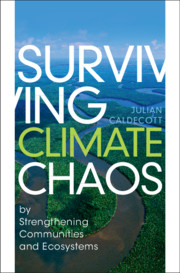
So there are ‘freedom from’ and ‘freedom for’ aspects to this, as there always are with freedom. But there are also more subtle positives. Imagine Scotland as a complex system. As I explain in my book Surviving Climate Chaos (Cambridge, 2021), all systems behave according to the nature of the entities within them and the relationships among those entities. In any country, these entities and relationships are shaped in deep time by geology and evolutionary biology, and in recent time by ecology, land use, language, myths and values.
All contribute to the froth of the immediate culture, which is stirred by currents from the depths and by breezes from near and far. Amongst the bubbles are determinants of hope and fear, desolation and purpose, colonies of energy and idea that shape everyone’s life experience. Sometimes a malign spore settles and grows, to infect part of the froth with a dark meme, ones like: you have NO purpose, so why not have a drink or shoot up? That one comes from the drug dealers. Or else: you HAVE a purpose, and it’s to grab and defend your own personal property in competition with everyone else, at any cost to them, and only if you fail will you be truly worthless! That one’s from capitalism.
Healthy systems have immunity to these parasitic memes, which aim to create vulnerability by fomenting purposelessness, or by distorting values so that the individual can never be fulfilled. Unconstrained, their effect is like one of those Cordyceps fungi in Merlin Sheldrake’s book Entangled Life (Bodley Head, 2020), that get into the brains of ants and make them climb high before dying to scatter spores on other ants below.
There are many places where peoples have died from the shock of contact with new cultures and dispiriting memes – the Americas and Australia are full of them – but we often forget the victims of the past in the dazzle of the present. More moving is to see a society that is withering under attack by squirming multitudes of parasites, the last old people bewildered and alone amidst new values and incomprehensible languages. Hundreds of cultures have died like this in my lifetime, and hundreds more, from the Highlands to the Amazon, are casualties in the annals of anthropology.
But here and there are societies that have survived. The Iban and Kelabit of Malaysian Borneo, the Balinese of Indonesia, and others, seem to manage by rooting themselves in themselves and the life-energy of their homelands, holding some core sense of identity close and having the confidence to use outsiders for their own purposes. And then there are those, like the Makushi of Guyana, the Zoque of Mexico and the Welsh, Basques and Catalans, who have managed to rebuild a sense of place and identity, where the infection has been halted, the language saved, solidarity and belonging re-established, and despair banished.
Part of it is blind luck, but luck without determination and cleverness is not enough. The Zoque, for example, started by bribing conquistadores with gold and were lucky enough to find one who left them alone in return. They kept on paying gold with the same purpose to successive governments, through independence from Spain and the Mexican revolution, until modern land surveyors mapped their ‘Chimalapas’ homeland as a community territory, the largest in Mexico. They also welcomed Amerindian genocide survivors, who were given land, adopted as Zoque, and helped to defend the area.
This worked for several hundred years, showing the value of creativity in seeking what’s really important: land tenure and a sense of identity, belonging, and a long-term purpose that means something. All of this is relevant to Scotland, which has striven to find its way back from a complex and damaging past as a vibrant, viable and renewed country. It is now easy to imagine Scotland as a green, healthy, creative and sociable nation with English and Gaelic as official languages, and maybe Doric and Scots too.
Which brings me to the last reason why I would vote for independence: that Scots are lucky enough to have the chance to be free. Many peoples never had this chance. Seizing the opportunity is important because people need hope and/or purpose or we get depressed and give up. We can do without one of them but not both: one or other will prevent feelings of desolation, and the degradation of self-harm. Being responsible for a local, familiar ecosystem and local, familiar people is an excellent way to nurture feelings of purpose. The sense of security from being surrounded by healthy ecosystems and trusted acquaintances is an excellent way to nurture feelings of hope.
Freedom and responsibility are gateways to these sources of hope and purpose for everyone. Scotland needs freedom for Scots to be hopeful and purposeful. And the world needs hopeful, purposeful Scots if it is ever to be free of injustice and humanity’s failed war with nature.
So, there are many useful things to do whatever the outcome of a vote on independence, and there are risks and opportunities in any course of action. But choosing independence would have the following inherent benefits:
- achieving freedom itself, and the responsibilities that come with it;
- reducing political risk, by leaving an England that is on a dangerous path;
- shocking England back to sanity, by leaving the Union after Brexit;
- helping to save the world, through wise social and environmental policies;
- building hope and purpose among the peoples of Scotland; and
- taking advantage of good fortune and the opportunity to be free.
© Julian Caldecott, 2021